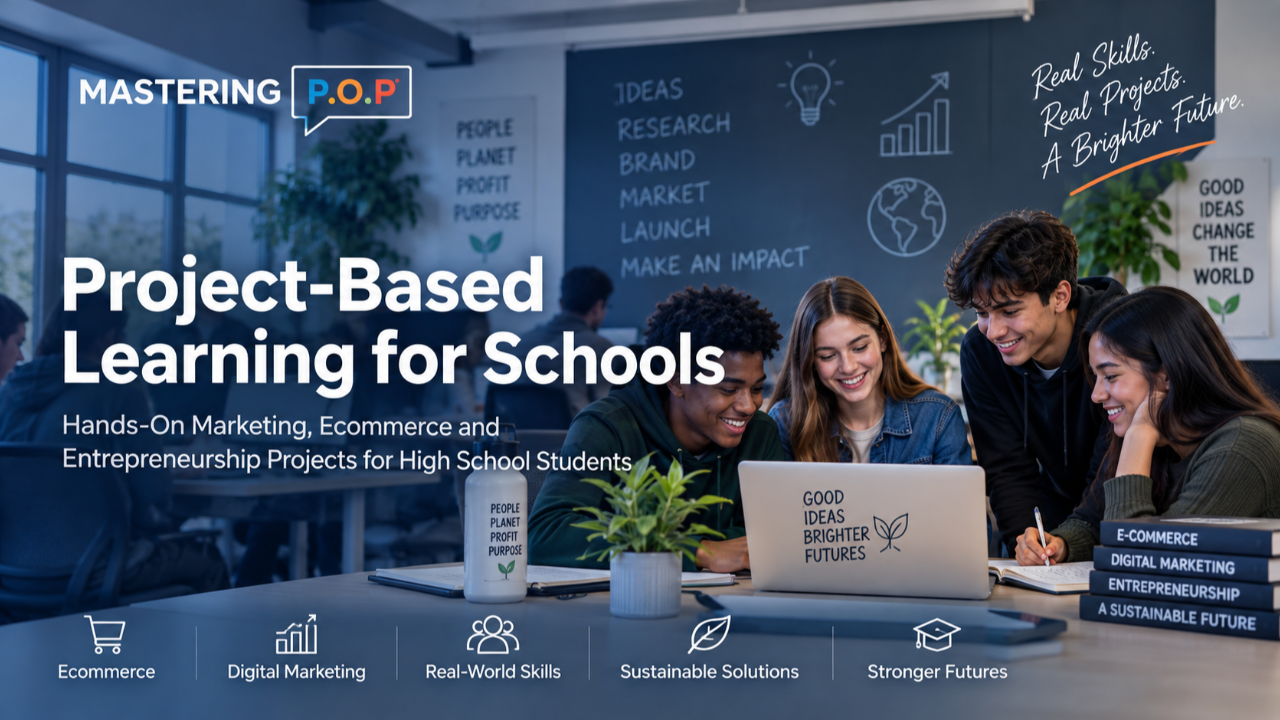
Real-world PBL marketing, e-commerce and entrepreneurship projects for high school students, schools and youth programs.
Project-based learning (PBL) gives students an opportunity to develop skills by actually applying what they're learning to a real-world project.
Mastering P.O.P.'s Project-Based Learning Marketing & E-commerce Program takes that concept into the world students already interact with every day: online stores, Google, brands, email, websites, social media, technology and e-commerce.
Students work through the process of developing an online business around products that solve a problem, are useful to people, or provide environmentally responsible alternatives.
Along the way, they learn e-commerce, branding, SEO, search intent, digital marketing, competitive research, lead generation, email marketing, conversion optimization, customer retention, strategic partnerships, Blue Ocean Strategy, analytics and the technology businesses use to bring products to market.
This isn't simply a classroom exercise about marketing.
Students learn by building, researching, testing, analyzing and making business decisions.
What Is Project-Based Learning?
Project-based learning is an educational approach in which students develop knowledge and skills by working on a meaningful project over an extended period of time.
Instead of learning a concept and moving on, students have to apply what they've learned to solve problems, make decisions, collaborate, research information and ultimately create something.
A PBL marketing project takes this same approach and applies it to business, e-commerce and digital marketing.
Rather than simply asking students to write a marketing plan for a fictional company, Mastering P.O.P. gives students a business project they can develop from the ground up.
A PBL Marketing Project Students Can Actually Build
Imagine giving students this challenge:
Develop an e-commerce business around products that solve a real problem, provide something useful, or offer an environmentally responsible alternative. Then figure out how to bring those products to market.
Students have to determine what they're going to sell and why.
- They research products and suppliers.
- They identify their target audience.
- They research competitors.
- They develop a brand.
- They build their online store.
Then comes the part many entrepreneurship projects leave out:
How are people going to find it?
Students learn how businesses attract the right traffic, generate leads, convert visitors into customers and encourage customers to purchase again.
That's where the project becomes much more than building a website.
What Students Learn
The Mastering P.O.P. program brings together multiple areas of business and digital marketing through one connected project.
Students can develop hands-on experience with:
- E-commerce
How online stores work, how products are organized and presented, and how customers move from discovering a product to purchasing it. - Branding
Developing a business identity, positioning, messaging and understanding what makes a brand recognizable and relevant. - SEO
Understanding how search engines discover and organize information and how businesses improve their visibility in search. - Search Intent
Learning that a keyword isn't simply a keyword. Students investigate what someone is actually trying to accomplish when they search. - The Right Traffic
More website traffic isn't automatically better. Students learn why attracting people who are actually interested in what they're selling matters more than chasing traffic numbers. - Competitive Research
Students study competing businesses, products, search results, positioning, pricing, content, customer experiences and marketing strategies. - Lead Generation
Students learn the difference between attracting a visitor and creating an opportunity to continue communicating with that person. - Email Marketing & Automation
Students learn how businesses use email to welcome subscribers, educate potential customers, promote products, recover potential lost sales and encourage repeat purchases. - Conversion Optimization
Students examine why people purchase, why they leave, and how product pages, messaging, navigation, calls to action, offers and other website elements influence behavior. - Customer Retention
The project doesn't end when someone purchases. Students learn why successful businesses work to turn first-time customers into repeat customers. - Content Marketing
Students learn how useful content can attract an audience, answer questions, build topical authority and support the customer journey. - Strategic Partnerships
Students identify businesses, organizations, creators and communities that already reach audiences relevant to their business and learn how mutually beneficial partnerships can create growth. - Blue Ocean Strategy
Instead of automatically competing with everyone selling similar products, students look for opportunities to differentiate their business and create a different reason for customers to choose them.
Profitability Over Popularity
One of the most important business lessons students learn in the program is: Being popular doesn't necessarily mean being profitable.
A business can have thousands of followers, viral videos and significant website traffic and still struggle to make money.
Another business can have a smaller audience and become profitable because it reaches the right people and understands how to convert and retain customers.
Students learn to look beyond likes, followers, views and impressions. They begin asking different questions.
- How much did we spend?
- How much did we sell?
- Where did our customers come from?
- Which traffic produced sales?
- Which products were profitable?
- How many visitors became customers?
- Did customers purchase again?
That's the difference between learning how to become popular online and learning how a business actually works.
Students Learn Search Intent Using Real Google Searches
Search intent is one of the concepts I particularly want students to understand.
Students can research actual Google searches related to their products and examine what appears.
- Are people looking for information?
- Are they comparing products?
- Are they looking for something to purchase?
- Do Google results show e-commerce stores, articles, videos, images, local businesses or something else?
Students begin to understand that getting a website to appear for a keyword isn't necessarily valuable if the business doesn't provide what that person was looking for.
That's how we move from teaching students about “website traffic” to teaching them about the right traffic.
Competitive Research Without Simply Copying Competitors
Students should know what competitors are doing, but the purpose of competitive research isn't to create another version of an existing business.
Students can analyze competitor websites, products, search visibility, content, offers, pricing, customer reviews, partnerships and positioning.
Then we ask another question: What aren't they doing?
This is where students are introduced to Blue Ocean Strategy and begin looking for opportunities instead of simply competing for the same customers in the same way.
Strategic Partnerships, Brand Jacking and Name Dropping
Businesses don't always have to build an audience from zero.
Students learn how legitimate associations with established businesses, platforms, suppliers, technology companies, organizations and partners can create visibility and credibility.
I refer to some of these strategies as brand jacking and name dropping. The lesson isn't to imply an endorsement that doesn't exist.
It's to understand how businesses can legitimately leverage the companies, platforms, integrations, partners and relationships already connected to what they do.
Students also learn to approach partnerships from the other organization's perspective: What's in it for them?
That introduces negotiation, communication, research and relationship building into the project.
Marketing Tools and Browser Extensions Students Can Use
Today's marketers don't work with textbooks alone.
Students are introduced to the types of tools businesses use for keyword research, SEO, e-commerce, analytics, competitive research, email marketing, lead generation, outreach, content creation and customer retention.
They can also learn how browser extensions make research easier by surfacing information while they're already searching Google or evaluating websites.
The objective isn't to memorize one particular software platform. Tools change.
Students learn how to use technology to answer business questions, research opportunities and make better decisions.
From Traffic to Repeat Customers
Students learn to see marketing as a connected system: Visibility > Traffic > Lead > Customer > Repeat Customer
That distinction is important. Getting someone to visit an online store isn't the finish line.
Students explore what happens after the visitor arrives, how businesses capture potential customers, how email and other channels continue the conversation, what influences a purchase and what can bring a customer back.
It gives students a much more complete picture of digital marketing.
Project-Based Learning Across Multiple Subjects
An e-commerce PBL project can incorporate much more than marketing.
Students use writing when creating product descriptions and marketing messages.
- They use mathematics when working with pricing, margins, discounts, conversion rates and profitability.
- They use technology to build and analyze their online business.
- They use research to evaluate products, markets, competitors and customers.
- They use communication when presenting ideas and developing partnerships.
- They use critical thinking when the data tells them something they expected to work isn't working.
Environmental considerations can also become part of product selection, sourcing, packaging and positioning.
The result is a project that can connect business, marketing, technology, mathematics, writing, entrepreneurship and environmental awareness rather than teaching each subject in isolation.
A Structured PBL Marketing & E-commerce Program
Mastering P.O.P.'s project based learning program is already structured around the stages students need to move through.
The curriculum includes:
- Project Fundamentals
Real-world problems and challenges, student-centered learning, critical thinking, problem solving, communication, collaboration, technology and final presentation. - Real World Problems & Solutions
Identifying a problem, researching products, researching suppliers and understanding the target audience. - Business Fundamentals
Business details, business structure and business planning. - Digital Marketing & SEO
Students move through workflows covering SEO, email marketing, conversion optimization, content marketing and partnership marketing. - Self Reflection & Assessment
Students evaluate their performance, decisions, results and what they would change.
Students can also earn achievement badges as they progress through the program, including areas such as research, problem solving, product sourcing, collaboration, technology, communication, digital marketing and business development.
Who Is the PBL Marketing Program For?
The program can be adapted for different educational and youth environments, including:
- High schools and secondary schools looking for hands-on project-based learning opportunities.
- Teachers and educators looking for real-world PBL projects involving business, technology, marketing or entrepreneurship.
- Principals and school administrators exploring experiential learning, career readiness and entrepreneurship programs.
- Career and Technical Education (CTE) programs looking to connect business, marketing and technology skills with applied projects.
- Business, marketing and entrepreneurship programs that want students applying concepts rather than only studying them.
- Colleges and community colleges looking for applied entrepreneurship, e-commerce or digital marketing projects.
- Afterschool programs and youth organizations looking for structured educational programming with practical business and technology skills.
- Boys & Girls Clubs and community organizations offering career exploration, entrepreneurship and workforce-readiness programming.
- Summer camps and academic camps looking for a multi-week business, e-commerce or entrepreneurship project.
- Business and entrepreneurship camps where students can develop a business concept and learn how to bring it to market.
- Sports and athlete development programs that incorporate entrepreneurship, business, career readiness, personal branding or related educational programming.
- PBL Resources for Teachers and Program Leaders
The program can include the resources needed to move students through the project rather than requiring an educator to build an e-commerce and digital marketing curriculum from scratch.
Depending on the program structure, resources can support product research, target audience research, competitive analysis, search intent, e-commerce, SEO, email marketing, conversion optimization, partnerships, presentation and assessment.
The program can also be adapted around the students' ages, available instructional time, program objectives and existing curriculum.
Bring PBL Marketing & E-commerce to Your Students
Mastering P.O.P.'s Project-Based Learning Marketing & E-commerce Program gives students an opportunity to experience how an online business is researched, developed, marketed and improved.
Students aren't simply being told how digital marketing works. They get to do the work.
The program can be used by schools, teachers, administrators, CTE programs, colleges, afterschool programs, youth organizations, Boys & Girls Clubs, academic camps, summer programs and entrepreneurship programs.
If you're an educator, principal, administrator, program director, camp director or youth organization interested in bringing a hands-on e-commerce and digital marketing project to your students, contact: tia@masteringpop.com or help@masteringpop.com or https://www.masteringpop.com/site/contact